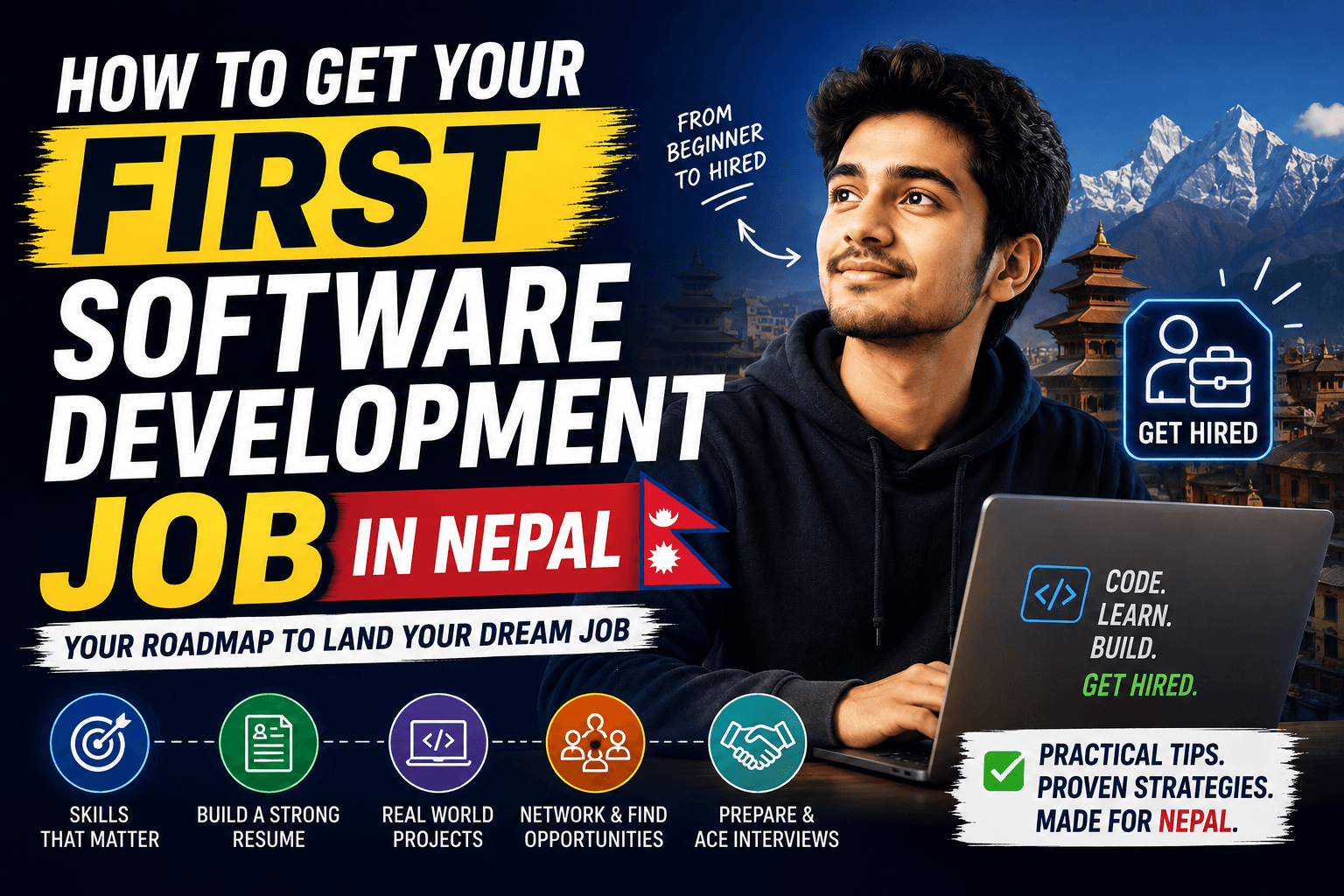
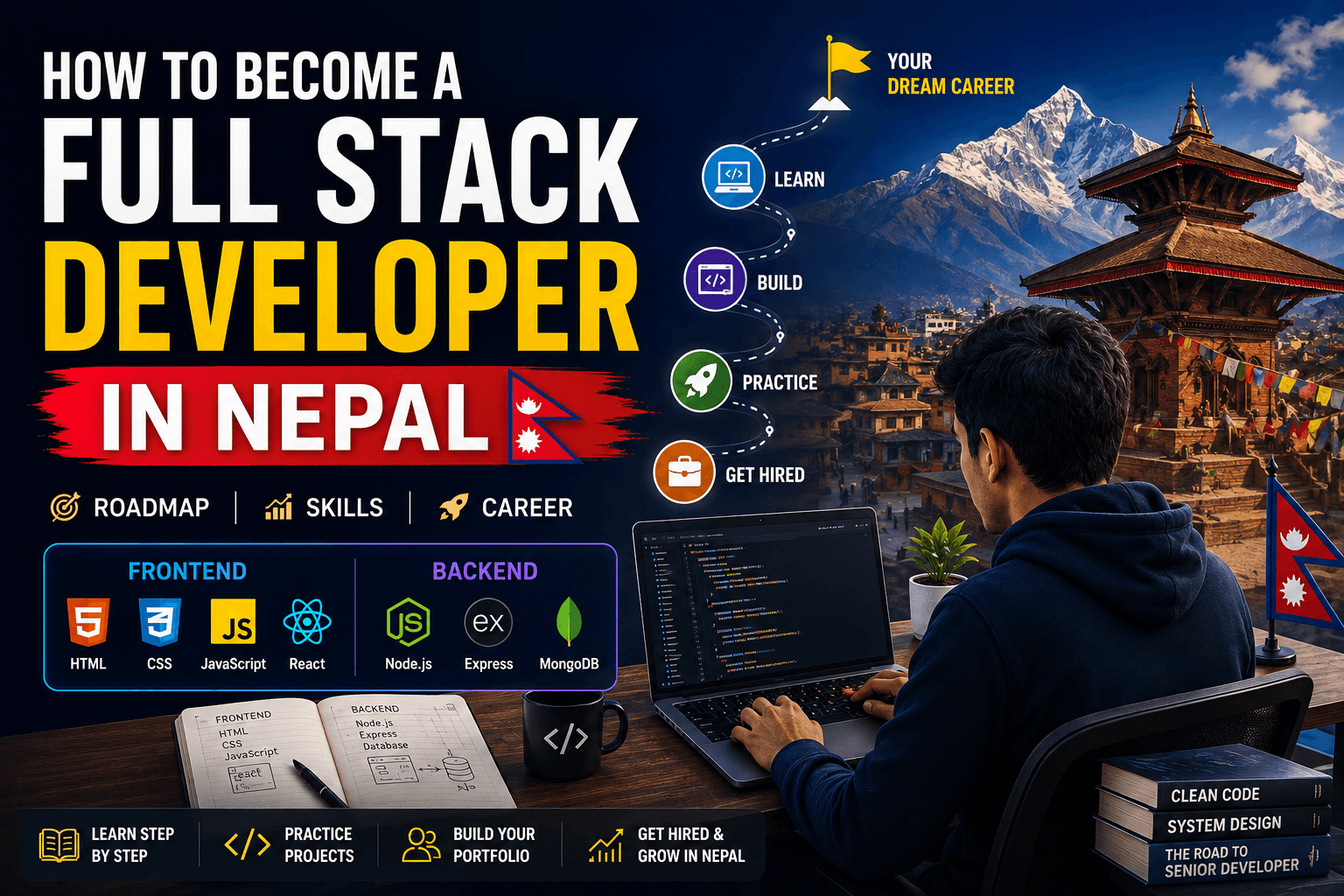
“Full stack developer in Nepal” is a search a lot of CSIT students and self-taught developers type when internships start appearing on Facebook groups and LinkedIn. The title is real. The job is not “know every framework.”
In Nepal you will usually be hired to ship features across the UI and the API on a small team — agencies, product companies, and a growing number of remote roles. This article is a practical path: skills, learning order, local context, projects, and interview prep. No invented salary tables, no fake hiring statistics.
Who this path is for
This is for you if:
- You are studying CSIT, BIT, BCA, or a related program — or you are switching from another field
- You can already build a simple website and want to own backend work too
- You want jobs in Kathmandu (and increasingly Pokhara / remote) where “full stack” means React or Next.js plus Node.js
It is not a promise that one roadmap gets you a senior title. Full stack juniors are expected to be dangerous on one side (usually frontend) and competent on the other (APIs, Postgres, auth). Depth still wins.
I studied B.Sc. CSIT at Bhaktapur Multiple Campus and now work as a full stack software developer. The degree helped with fundamentals. The portfolio and shipped products did the rest.
What “full stack” means in Nepali teams
In practice the stack is often:
- Frontend: React, Next.js, TypeScript, Tailwind
- Backend: Node.js, Express or NestJS, REST APIs
- Data: PostgreSQL or MongoDB
- Auth & payments: JWT/sessions, and for local products — Khalti or eSewa
- Deploy: Vercel, a VPS, Docker, sometimes cPanel-era hosting you have to reason about
Service companies may put you on WordPress or a random PHP admin on Monday and a React dashboard on Thursday. Product companies tend to keep you on one codebase longer. Both exist. Read the job post: “full stack” can mean “we have five people and you will touch everything.”
Remote work for foreign clients is available if your English, Git hygiene, and timezone communication are solid. That is a skill, not a buzzword.
Skills to learn (in a hireable order)
1. Web fundamentals
HTML, CSS, JavaScript. If you cannot center a layout or explain async/await,
React will only hide the gap until the first production bug.
2. TypeScript
Almost every serious codebase I join uses TypeScript on both sides. Learn it
on small programs before you sprinkle any through a NestJS module.
3. React, then Next.js
React is still the frontend employers recognize. Next.js is how you ship marketing pages, SEO, and dashboards in one repo. Start with How to Become a React Developer, then add App Router, Server Components, and metadata.
4. Node.js APIs
Express is fine to learn HTTP. NestJS shows up in production backends because
modules, guards, and validation scale better than a single server.js. You
do not need both on day one. You need one API with auth, validation, and a
database.
5. PostgreSQL
Relational data is what invoices, memberships, and multi-tenant SaaS actually run on. MongoDB is useful; it is not a substitute for understanding joins, indexes, and transactions. I wrote about a pattern you will meet in SaaS: modeling multi-tenant data in PostgreSQL.
6. Git, Linux comfort, and deployment
Pushing to GitHub is not DevOps. You should be able to:
- Set environment variables
- Run a production build
- Read a deploy log
- Know why a site that “works on your laptop” fails for a visitor in Nepal on shared hosting — see why Nepali visitors get blocked
Recommended learning order
A year-shaped plan, not a weekend:
- Months 1–2: HTML, CSS, JavaScript, Git
- Months 3–4: React + TypeScript, one deployed UI
- Months 5–6: Next.js App Router, forms, auth-aware pages
- Months 7–8: Node.js + PostgreSQL, REST, JWT or session auth
- Months 9–10: One full project that uses both sides, including payments or file uploads
- Ongoing: Read other people’s PRs, write a short case study, apply while you still feel 70% ready
University labs will not replace this. Treat semester projects as portfolio pieces if you finish them like products — README, live URL, real validation.
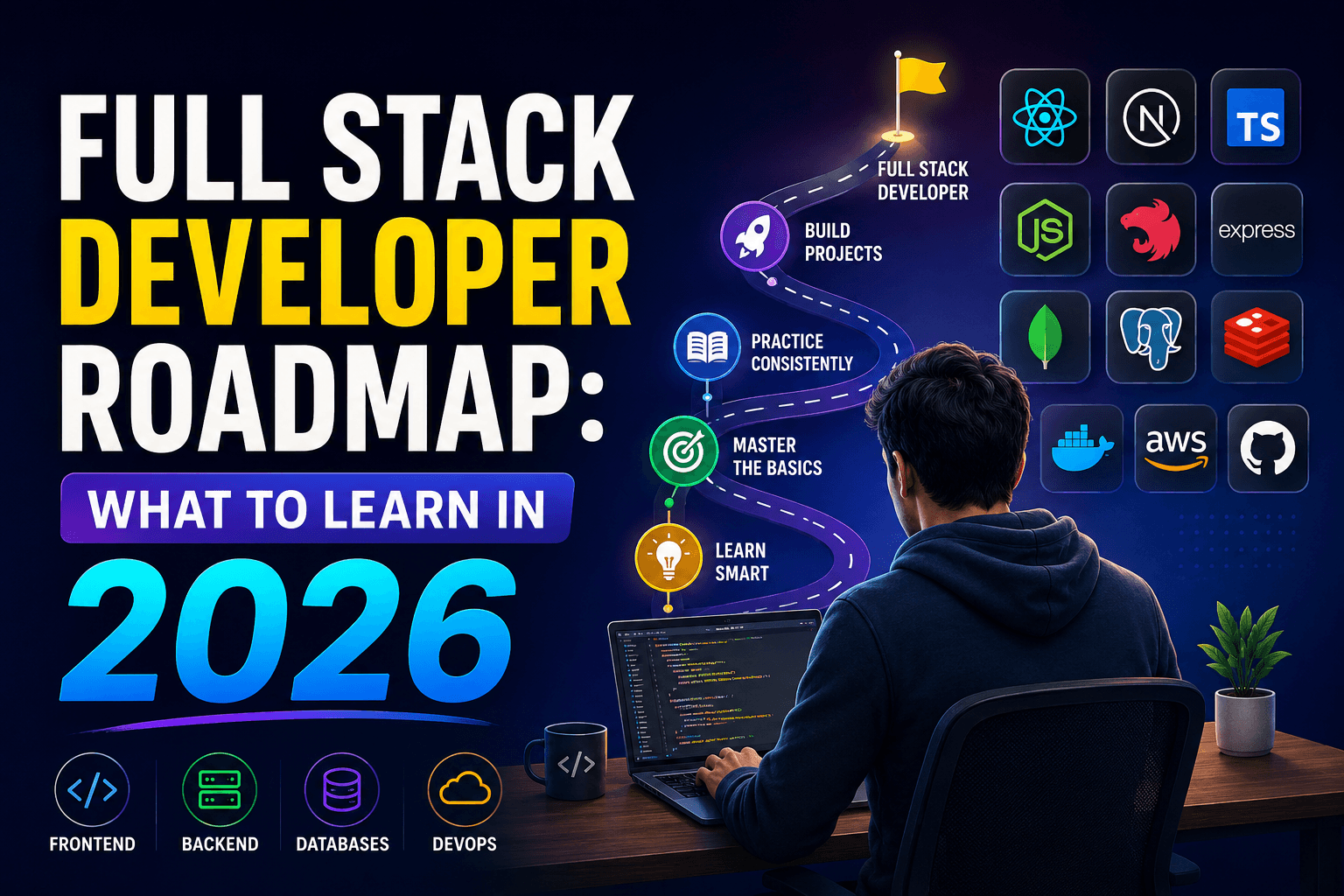
For a technology-first map without the Nepal-specific hiring notes, use the Full Stack Developer Roadmap for 2026.
Projects that work in this market
Hiring managers here still click GitHub. They also ask “is it live?”
A Nepal-relevant product slice
Examples that map to real work:
- Clinic or pharmacy-style portal (I spent years in healthcare at Upachaar Nepal)
- Gym or coaching dashboard with roles
- Travel or ecommerce catalog with an admin
You do not need to clone a whole hospital. You need auth, a list, a detail page, and an admin mutation with validation.
Local payments
Integrating Khalti or eSewa is a differentiator for Nepal-facing products. Foreign tutorials will not cover signature verification the way production does. Those two posts above are written from that constraint.
SEO + performance on a public site
Agencies sell websites. If you can explain metadata, Core Web Vitals, and why a client-only React app ranks poorly, you are more useful than someone who only built a dashboard. Read How to Build SEO-Friendly Apps with Next.js.
Ship them. Put them on a projects page with a short write-up.
Common mistakes I see locally
Collecting certificates instead of repos. A Udemy completion PDF does not replace a deployed app.
Copy-pasting MERN tutorials with no types and no error handling. Interviewers will ask what happens when the API returns 500.
Ignoring English and written communication. Standups and client Slack are part of the job, including for Kathmandu offices.
Waiting for a “perfect” CSIT GPA. Some teams care. Many care more that you can debug.
Applying only to FAANG-shaped job descriptions. Most openings are smaller companies that want someone who can ship next week.
Never reading production constraints — payments, permissions, multi-tenant data. Those are the tickets you will actually pick up. Look at GymGrow or Striide as examples of product surface area, not as things you must clone.
How to get job-ready in this market
- Finish one full-stack project with login, CRUD, and a deploy URL
- Keep GitHub green with real commits, not one dump before you apply
- Write a short About page — who you are, stack, what you want. Start from how you present work on an about page: stack, location, intent
- Do internships and freelance carefully. Unpaid “exposure” with no mentorship teaches you to normalize chaos. Prefer teams that review your PRs
- Learn to estimate. “It will take two days” is a skill. Track yourself
CV: one page, live links on top, stack in the tools they use (React, Next.js, Node.js, PostgreSQL). Tailor the first bullet to the company.
Interviews
Typical rounds:
- HR / intro — availability, notice, why this company
- Technical talk — a project deep dive. They will poke the hardest part
- Live coding — JS plus a small React component or an Express route
- Sometimes SQL —
JOIN, indexes at a basic level
Prepare a 5-minute walkthrough of your best project: problem, users, schema, the nastiest bug, what you would redo.
Do not memorize salary screenshots from Twitter. Compensation varies wildly by company size, remote vs on-site, and whether they bill in NPR or foreign currency. Ask peers you trust, not a blog post.
Conclusion
Becoming a full stack developer in Nepal is a craft path: TypeScript, React and Next.js, Node.js, PostgreSQL, then proof — live products, local payment literacy, and the ability to talk through a system.
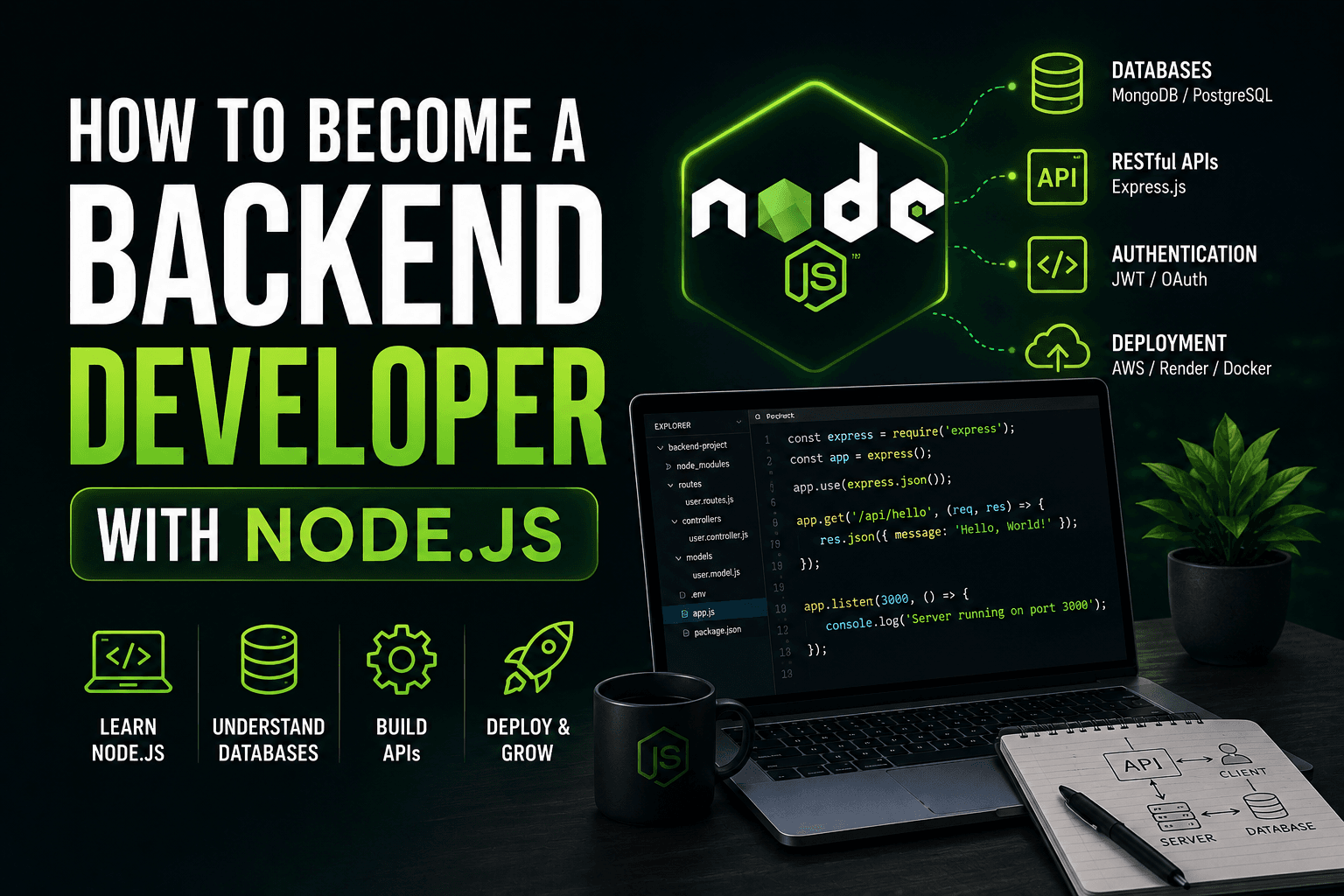
University gives you a foundation. GitHub and shipped work get you into the room. If you want the backend-heavy variant of this career, continue with How to Become a Backend Developer with Node.js.
Pick one product idea this month. Ship a thin slice. Then make it harder: roles, payments, or a second tenant.