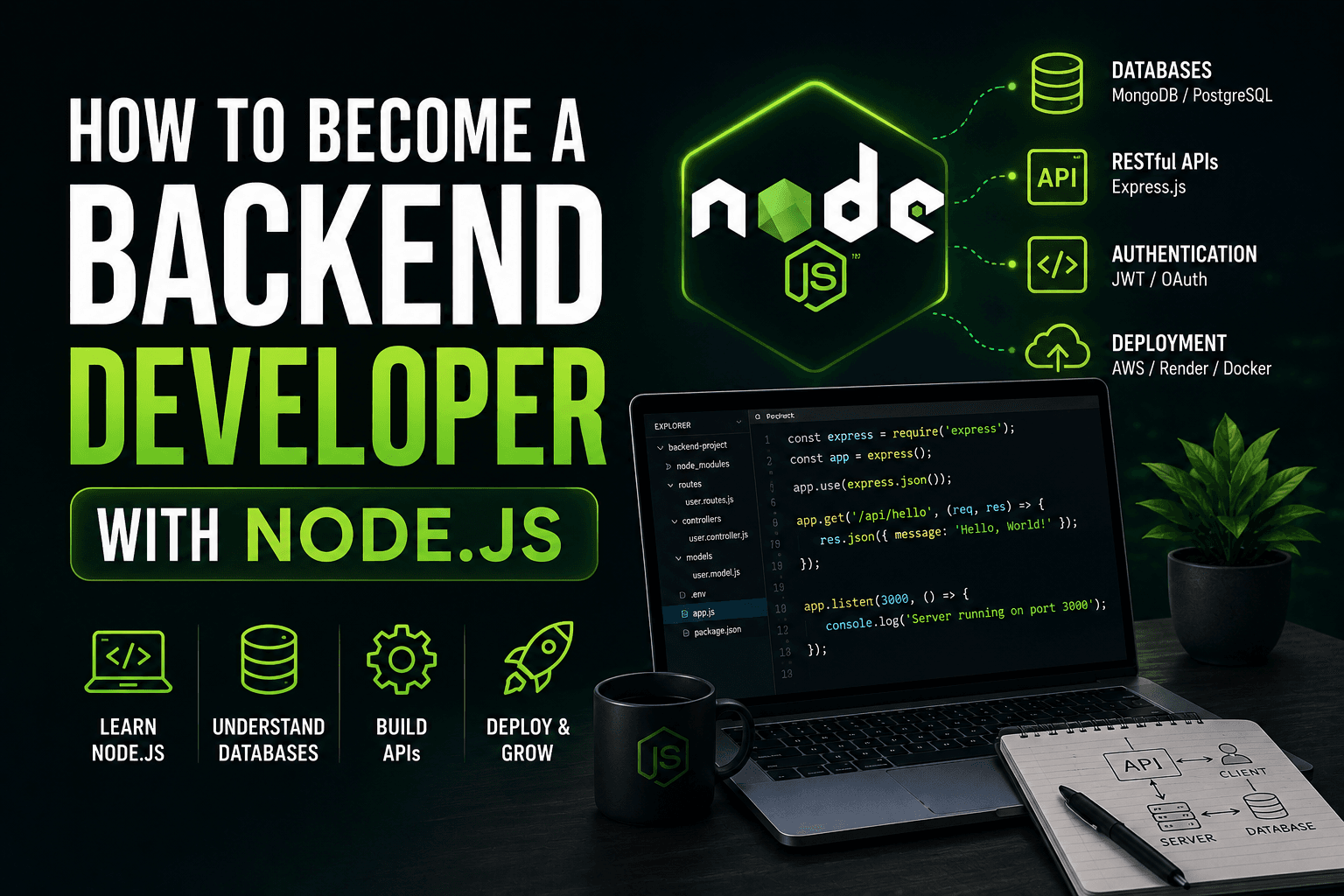
A Node.js backend developer is hired to keep data correct under concurrent users, not to print “Hello World” on port 3000. The career path is HTTP, modeling, auth, observability, and a calm production story.
This guide is for people who like systems more than pixels — and for full stack developers who want the API side to stop being a weak spot. It overlaps with the full stack roadmap but goes deeper on server work.
Who this path is for
- You enjoy SQL, logs, and “why did this webhook fire twice?”
- You are fine if the UI is someone else’s Figma
- You want roles titled backend, API, or Node.js developer
You still need enough HTTP-client empathy to design APIs that Next.js and mobile apps can consume. Backend is not isolation from users. It is isolation from CSS.
What the job actually is
On a product team you will:
- Design tables and indexes
- Write authorization that cannot be bypassed from the React app
- Integrate payments and retries
- Debug production with logs, not
console.logleft in a PR - Care about migrations and backward compatibility
I do this work in NestJS services behind dashboards like GymGrow and healthcare portals from Upachaar Nepal. The UI changes. The invariants (money, membership, tenant isolation) do not.
Skills to learn
1. JavaScript/TypeScript on the server
ES modules, async/await, streams at a basic level, error-first thinking.
TypeScript for DTOs and domain types. If you skip types, you will ship
undefined into Postgres.
2. HTTP
Methods, idempotency, status codes, pagination, file uploads, CORS as a conscious choice. REST is still the lingua franca of job interviews.
3. PostgreSQL
This is the hireable database. Learn:
- Normalization vs when to denormalize
- Indexes and
EXPLAIN - Transactions
- Migrations as code
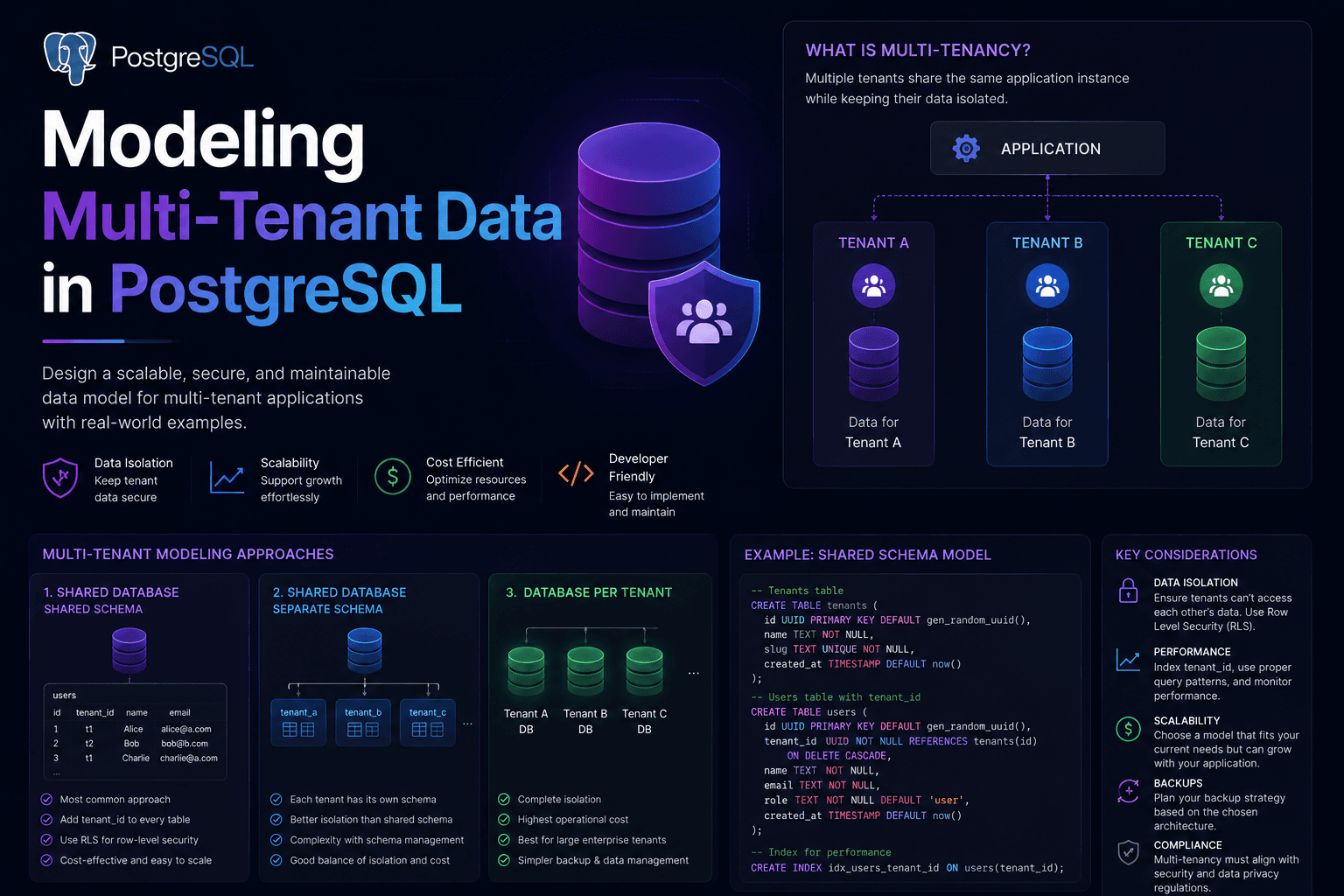
MongoDB is a tool. It is not a substitute for relational literacy. When you hit SaaS, read Modeling Multi-Tenant Data in PostgreSQL.
4. Node frameworks
Express — understand middleware and routing.
NestJS — modules, providers, guards, pipes. This is what many production Node teams use when the API is more than five routes.
You can get a first job on Express. You will look more senior if you can
structure a NestJS app without putting everything in AppService.
5. Auth and security
Password hashing, session vs JWT, cookies, CSRF where it applies, secrets in env files, SQL injection via ORMs used badly. OWASP top issues, not a certification badge.
6. Testing the risky layer
You do not need 90% coverage. You need tests on:
- Authz (can tenant A read tenant B?)
- Money and status transitions
- Webhook signature verification
7. Deploy and operate
Process manager or containers, logs, health checks, migrations in CI. Dockerizing is a frontend example, but multi-stage builds and small images apply to NestJS too.
Recommended learning order
- TypeScript + HTTP with a tiny Express app
- Postgres + a migration tool (Prisma, Drizzle, or raw SQL — pick one)
- Auth (register/login) with hashed passwords
- NestJS rewrite or NestJS from scratch once Express feels messy
- Background jobs (email) so you do not block the request
- Redis if you need cache or rate limits
- Load basics: pooling, pagination — then How to Scale APIs with Node.js
Skip Kafka, Kubernetes, and “microservices” until a single well-modular NestJS app is boring.
Tools
- NestJS or Express
- PostgreSQL
- Prisma or Drizzle — still learn the SQL they emit
- Zod or class-validator
- Redis later
- OpenAPI if other teams consume your API
- Postman / Bruno / REST Client for manual checks
- GitHub Actions for test + migrate + deploy
Frontend-adjacent: enough Next.js to consume your own API. You do not need to be the CSS owner.
Projects that get you interviews
1. A resource API with tenancy
org_id on every table. Tests that prove cross-org reads fail. This is the
project that beats yet another blog API.
2. Webhooks
Stripe test mode or a fake provider. Replay events. Idempotency keys. This is closer to production than a second todo list.
3. Local payments (if you target Nepal)
Khalti and eSewa are backend problems: signatures, amount verification, and state machines. They also make your Nepal full stack story more concrete.
4. An admin export
CSV or PDF generated in a worker, not in the HTTP process.
Document each project: schema diagram, threat model in five bullets, how to run migrations.
Common mistakes
Business logic in controllers. Controllers should parse HTTP. Domain belongs in services.
No transactions around “create invoice + decrement stock.”
Trusting the frontend for role: "admin".
Unbounded lists. Your first scale incident is a table scan.
Tutorial folder structure (routes/, controllers/) with no module
boundaries once you have 40 endpoints.
Never reading logs in staging. Backend work is operational.
How to become job-ready
- One deployed API with migrations and a README
- OpenAPI or a written endpoint list
- Tests on authorization
- A story about a bug you found with
EXPLAINor a log line - Comfortable in Git and code review
CV: Node.js, TypeScript, PostgreSQL, NestJS, REST. Link the repo. Link
/health if it is live.
Interviews: JS event loop (honest, not memorized TED-talk), SQL, “design a URL shortener” at junior-mid level, and a deep dive into your schema.
For Nepal and mixed full stack roles, you will still be asked React questions. Be able to talk to the UI without pretending you want to own animations.
Conclusion
Becoming a backend developer with Node.js means TypeScript, HTTP, PostgreSQL, structured NestJS (or very disciplined Express), authz, and production habits. CRUD tutorials are the first week. Tenancy, webhooks, and bounded queries are the job.
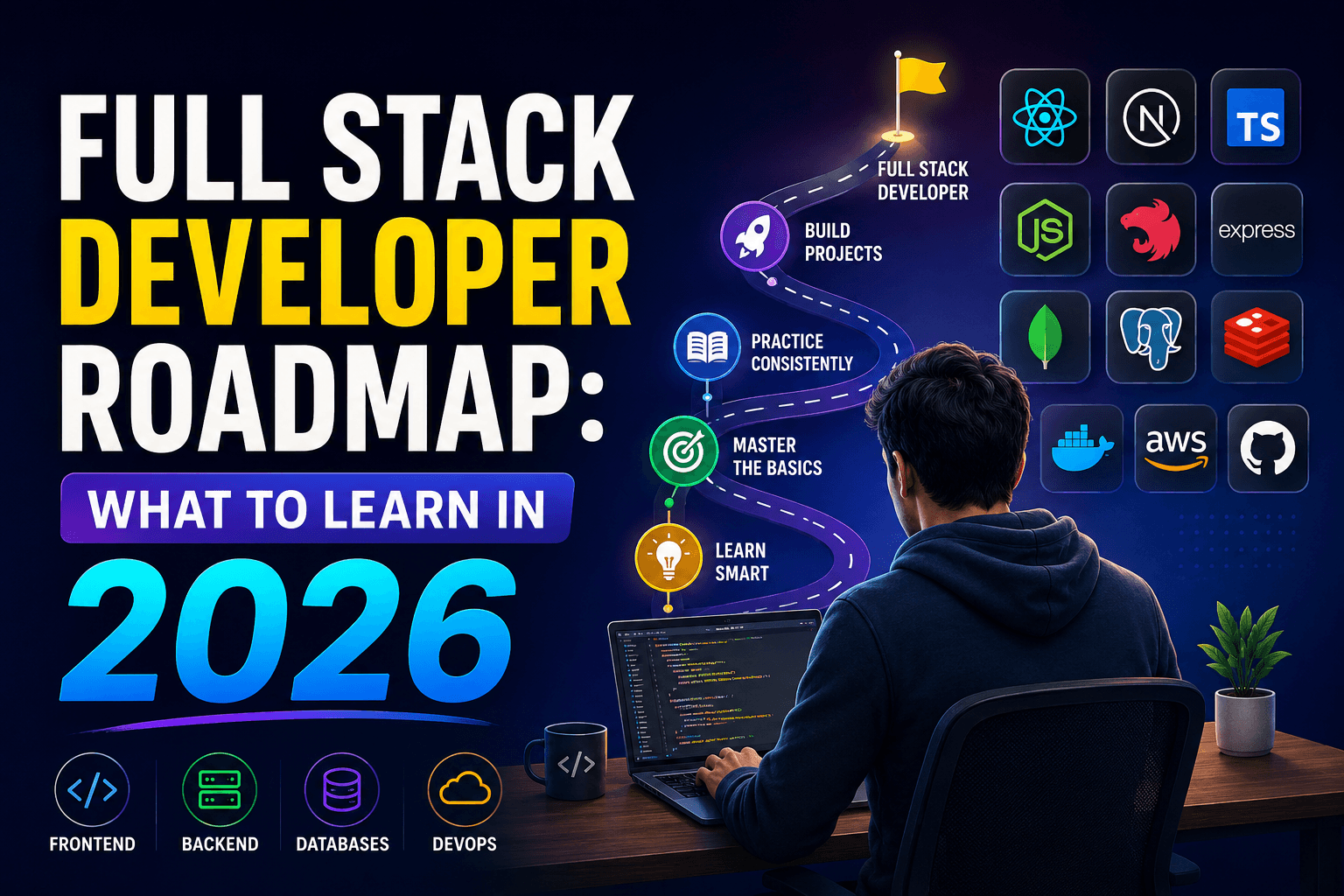
If you want the scaling playbook next, open the Node.js scaling article. If you still need the wider career map, stay on the 2026 full stack roadmap until your API and UI meet in one deployed product.
Keep the data correct. The rest of the stack can be fashionable later.