Multi-tenant SaaS almost always starts with one question that looks simple and is not: where does tenant data live?
If you get the data model wrong, every feature after it becomes harder — permissions, reporting, migrations, backups, and incident response. If you get it right, NestJS services, Prisma queries, and Next.js dashboards stay boring in the best way.
This article covers practical PostgreSQL approaches to multi-tenancy: shared schemas, tenant columns, isolation boundaries, indexes, and the engineering trade-offs I weigh when designing backend systems.
What “tenant” means in the database
A tenant is the isolation boundary for a customer organization — a company, a gym, a clinic, a workspace.
Every row that belongs to a tenant should answer:
- Which tenant owns this?
- Can this request legally access it?
- Can we query it efficiently at scale?
If your API can fetch another tenant’s invoice by guessing an ID, the schema did not fail alone — the access path failed. The schema should make the correct path the easy path.
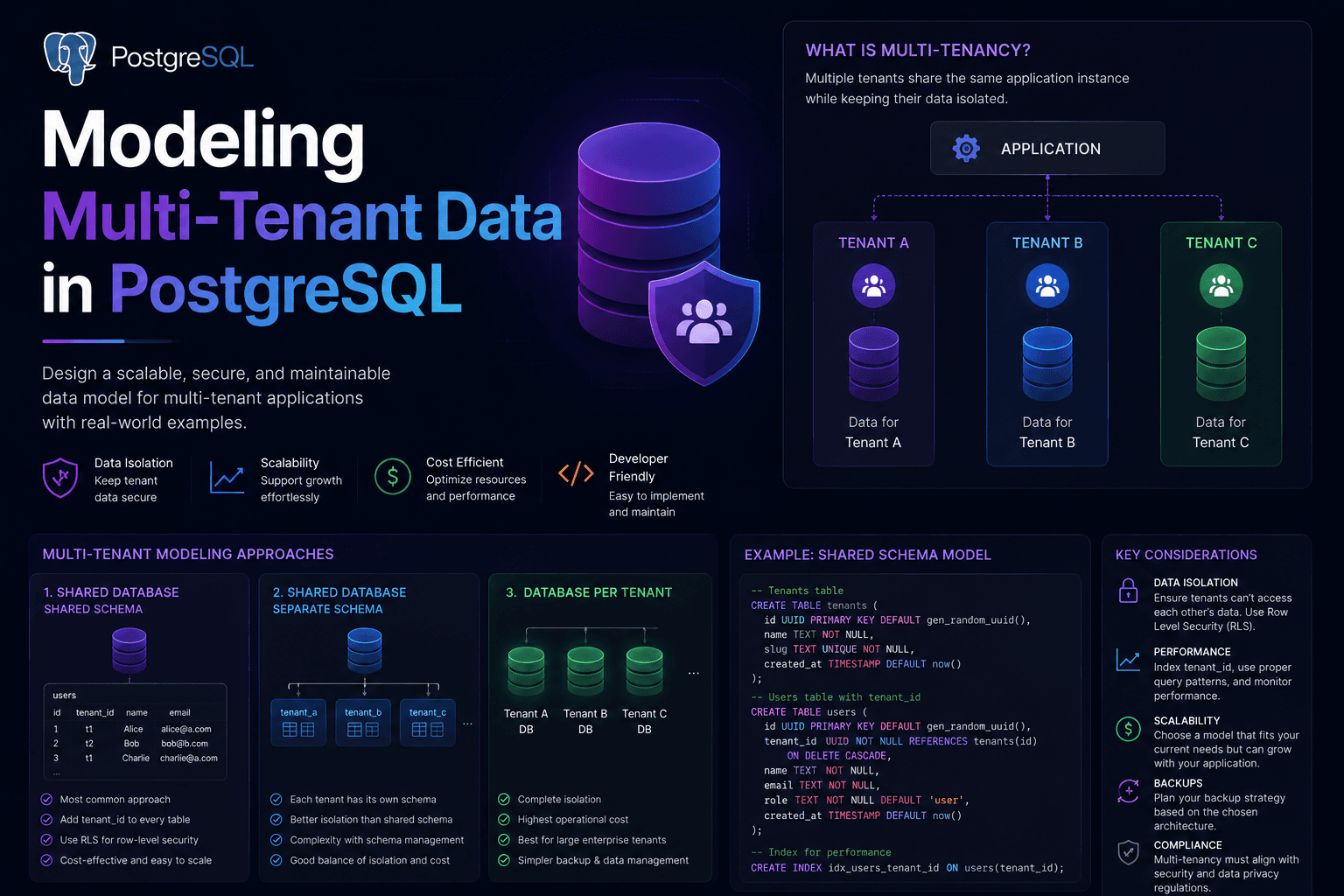
Three common isolation strategies
1. Database-per-tenant
Each tenant gets its own PostgreSQL database (or cluster).
Strengths
- Strong isolation
- Straightforward per-tenant backup/restore
- No accidental cross-tenant joins
Costs
- Operational overhead grows with tenant count
- Migrations must roll out many times
- Connection pooling and provisioning get expensive
Use this when isolation, compliance, or noisy-neighbor risk dominate — not as the default for early SaaS.
2. Schema-per-tenant
One database, one PostgreSQL schema per tenant.
Strengths
- Better isolation than a shared table
- Still one server to operate
Costs
- Schema proliferation
- Tooling and migrations become awkward
- Cross-tenant analytics are painful
This can work for a moderate number of larger tenants. It rarely ages well as a default for product-led growth.
3. Shared tables with a tenant key
One schema, shared tables, every tenant-owned row carries tenant_id.
Strengths
- Simple operations
- One migration path
- Easy global observability
Costs
- Isolation depends on application discipline
- One bad query can leak data
- Hot tenants can contend for shared resources
This is the most common SaaS starting point — and the one this article focuses on — because it scales operationally when paired with strict query conventions.
The shared-table model that stays safe
At minimum, tenant-owned tables look like this:
1create table tenants (
2id uuid primary key,
3name text not null,
4created_at timestamptz not null default now()
5);
6
7create table members (
8id uuid primary key,
9tenant_id uuid not null references tenants (id),
10email text not null,
11status text not null,
12created_at timestamptz not null default now()
13);
14
15create unique index members_tenant_email_uidx
16on members (tenant_id, email);
17
18create index members_tenant_id_idx
19on members (tenant_id);
Notice the unique constraint is (tenant_id, email), not email alone.
Global uniqueness is often wrong in multi-tenant systems.
Composite identity thinking
Many entities should be treated as unique within a tenant:
- member email
- branch slug
- invoice number
- role name
Make that explicit in constraints. The database should reject illegal states even if application code forgets.
Always scope queries by tenant
The most important backend rule:
Every read and write for tenant data includes
tenant_idfrom a trusted source.
Trusted means: session, verified JWT claim, or server-side membership lookup — not a client-supplied header you casually trust.
Bad
1// Dangerous: IDOR waiting to happen
2const member = await db.member.findUnique({
3where: { id: memberId },
4});
Better
1const member = await db.member.findFirst({
2where: {
3  id: memberId,
4  tenantId: access.tenantId,
5},
6});
7
8if (!member) {
9throw new NotFoundException();
10}
Even with Prisma, NestJS, or raw SQL, the pattern is the same: tenant scope is part of the predicate, not an afterthought.
In NestJS, I prefer a request-scoped tenant context set after authentication, then repositories/services that refuse to run tenant queries without it.
Indexes that match access patterns
Multi-tenant tables are often filtered by tenant_id first. Design indexes for
that.
Typical patterns
1-- List members in a tenant
2create index members_tenant_created_idx
3on members (tenant_id, created_at desc);
4
5-- Lookup by business key inside a tenant
6create unique index invoices_tenant_number_uidx
7on invoices (tenant_id, number);
8
9-- Foreign-key style child tables
10create index memberships_tenant_member_idx
11on memberships (tenant_id, member_id);
A lone index on id is not enough when almost every query also filters by
tenant.
If you use soft deletes, include them carefully in partial indexes:
1create unique index members_active_email_uidx
2on members (tenant_id, email)
3where deleted_at is null;
Foreign keys and cascading decisions
Keep foreign keys tenant-aware in spirit even when PostgreSQL cannot express “same tenant” in one FK easily.
Practical approaches:
- Application invariant — parent and child must share
tenant_id; enforce in services and tests. - Composite foreign keys — where helpful, reference
(tenant_id, id)so the child cannot point at a parent from another tenant.
Example composite style:
1create table branches (
2tenant_id uuid not null references tenants (id),
3id uuid not null,
4name text not null,
5primary key (tenant_id, id)
6);
7
8create table staff (
9tenant_id uuid not null,
10id uuid not null,
11branch_id uuid not null,
12primary key (tenant_id, id),
13foreign key (tenant_id, branch_id)
14references branches (tenant_id, id)
15);
Composite keys add verbosity. They also make illegal cross-tenant relationships much harder. Choose based on how catastrophic a cross-tenant FK would be.
Platform admins vs tenant users
Many products have both:
- tenant users — scoped to one organization
- platform operators — can inspect or support across tenants
Do not model this by omitting tenant_id on shared tables. Keep tenant ownership
intact and grant elevated application capabilities separately.
Cross-tenant admin queries should be explicit, audited, and rare. Quietly bypassing tenant filters for convenience is how support tools become breach tools.
Prisma notes without magic
Prisma works well with shared-table multi-tenancy if you stay disciplined:
- Put
tenantIdon tenant-owned models. - Prefer queries that always include
tenantId. - Use interactive transactions when creating parent/child graphs that must share one tenant.
- Avoid “find by id only” helpers for tenant resources.
A thin repository wrapper can help:
1async function findMemberForTenant(
2tenantId: string,
3memberId: string,
4) {
5return prisma.member.findFirst({
6  where: { tenantId, id: memberId },
7});
8}
The goal is not clever abstractions. The goal is making the unsafe query harder to write than the safe one.
Caching and Redis
If you cache tenant data in Redis, namespace keys by tenant:
1const memberKey = (tenantId: string, memberId: string) =>
2`tenant:${tenantId}:member:${memberId}`;
Never cache a record under a global id key and then serve it to whichever tenant asks. Cache invalidation should also be tenant-scoped when a tenant’s data changes.
Trade-offs to decide early
Shared DB vs stronger isolation
Start shared if you need speed of iteration and one operations story. Move hot or regulated tenants toward stronger isolation only when evidence demands it.
uuid vs bigint tenant keys
UUIDs are convenient for public IDs and merging environments. Bigints can be smaller and faster. Either works if used consistently and indexed properly.
Soft delete vs hard delete
Soft delete helps recovery and audit trails. It complicates uniqueness and indexes. Decide intentionally and encode the decision in constraints.
Row Level Security (RLS)
PostgreSQL RLS can enforce tenant isolation at the database layer. It is powerful and operationally serious: every connection role, migration, and admin path must understand policies. Worth considering when the threat model demands defense in depth — not as a substitute for clean application queries.
Common mistakes
- Unique constraints without tenant scope — one customer blocks another’s email.
- Trusting client-provided tenant IDs — tenancy becomes a spoofable header.
findByIdeverywhere — classic IDOR pattern.- Missing composite indexes — tenant list endpoints get slow quietly.
- Cross-tenant analytics via copy-paste SQL — one forgotten filter leaks data.
- Caching without tenant namespacing — stale or leaked records across accounts.
- Migrating tenancy later “when we scale” — tenancy is hardest to retrofit.
Practical recommendations
- Default to shared tables with a mandatory
tenant_id. - Make tenant scope part of every repository method for tenant data.
- Encode tenant-local uniqueness in PostgreSQL constraints.
- Index
(tenant_id, …)for your real query patterns. - Keep platform-admin cross-tenant access explicit and audited.
- Namespace Redis keys by tenant.
- Add automated tests that prove tenant A cannot read tenant B’s resources.
- Document the tenancy model for frontend and backend teams so Next.js apps and NestJS services share the same assumptions.
Conclusion
Multi-tenant PostgreSQL design is less about picking a fashionable pattern and more about making isolation boring and enforceable.
Shared tables with a strict tenant key remain a strong default for many SaaS backends. They work when queries are always scoped, constraints are honest, and indexes match how the product actually reads data.
If you are building with PostgreSQL, Node.js, NestJS, or Prisma, treat tenancy as part of the domain model — not a column you sprinkle on at the end. The database will remember the shortcuts you take.