Most Node.js APIs do not fail because Node “cannot scale.” They fail because the first version was a single process, a chatty database, and a route that does N+1 queries under a dashboard that 40 staff members open at 9:00.
Scaling is not a Kubernetes certificate. It is a sequence: measure, remove obvious waste, protect the database, then add capacity. This article is the approach I use on NestJS and Express services that sit behind React and Next.js clients.
The problem
A typical v1 looks like this:
- One Node process on a VPS
- Every request hits PostgreSQL
- Lists are
SELECT *with no pagination - File uploads and PDF generation run on the same event loop as checkout
- No timeouts, no idempotency, no cache
It works for a demo and for the first paying tenant. Then a report endpoint locks rows, or a traffic spike from a campaign turns p95 latency into a support ticket.
Why it matters
Unscaled APIs show up as:
- Timeouts in the Next.js app (which users blame on “the frontend”)
- Connection pool exhaustion (
too many clients already) - One slow tenant ruining everyone else on a shared schema
- Duplicate charges because a webhook retried and your handler was not idempotent
If you are building SaaS — gyms, clinics, coaching platforms — you will hit this. The UI can be perfect and still feel broken.
Measure before you multiply machines
Add the cheap instrumentation first:
- Request duration per route
- Database query time and row counts
- Error rate and timeout rate
- Pool wait time
You cannot scale what you cannot name. “It feels slow” is not a bottleneck.
A simple pattern: log route, status, ms, and tenantId on every
response. After a week you will know if the problem is GET /members or
POST /webhooks/stripe.
Core concepts that actually move the needle
1. Node is great at I/O, bad at heavy CPU
JSON parsing, crypto in reasonable amounts, and waiting on Postgres are fine. Video transcoding, huge CSV parses, and image pipelines should leave the request worker — queue them.
2. Horizontal scale needs a stateless API
If session state or uploads live in process memory, a second instance will lie. Store sessions in Redis or signed cookies. Store files in object storage.
3. The database is usually the real ceiling
Node can accept 2,000 concurrent connections. PostgreSQL will not happily run
2,000 unindexed ILIKE '%q%' queries. Scale the query, then the instance
count.
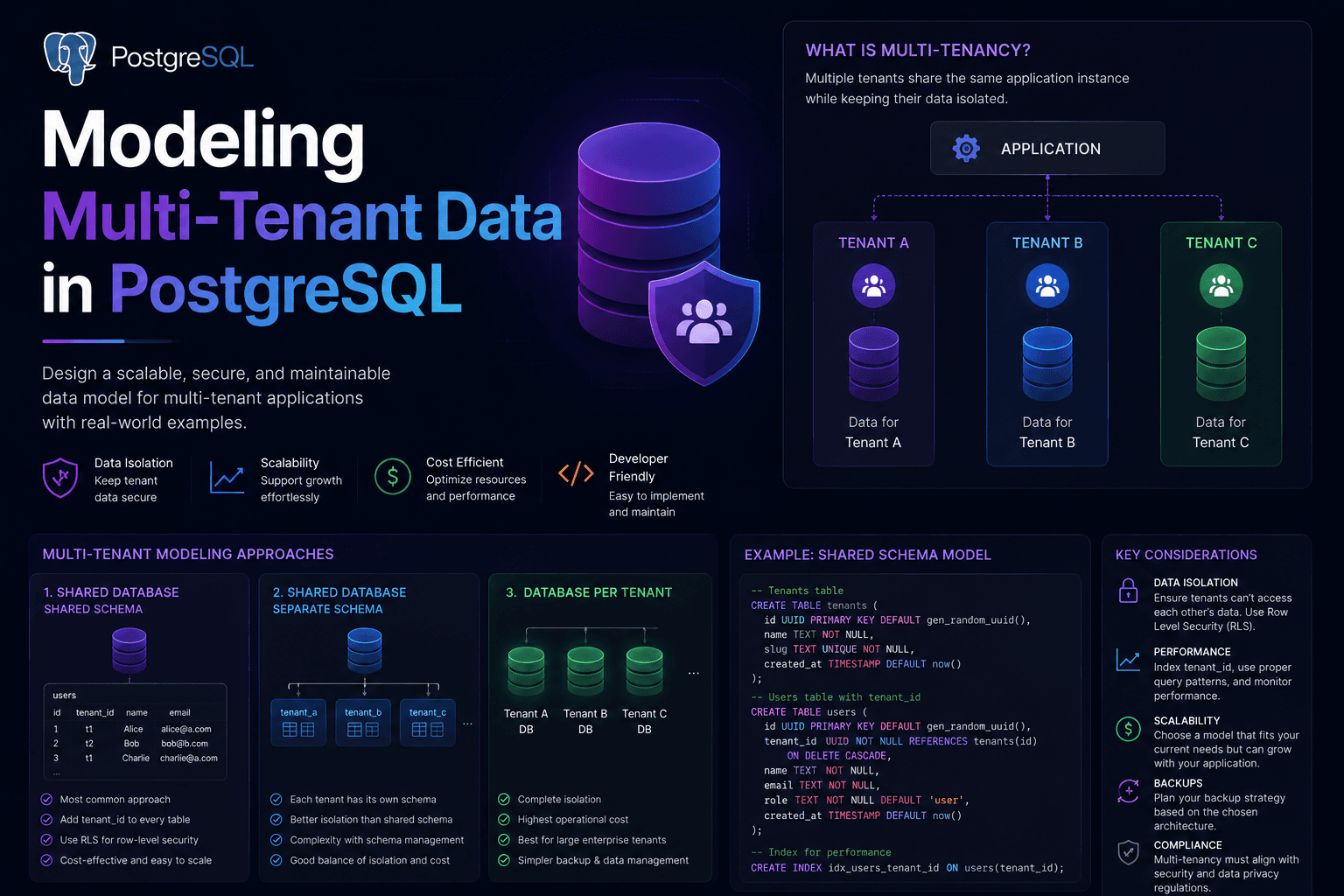
For tenant-heavy products, isolation and indexes matter as much as RAM. See Modeling Multi-Tenant Data in PostgreSQL.
A practical order of work
Step 1: Make the hot path cheap
- Pagination on every list (
cursororlimit/offsetwith a cap) - Select only needed columns
- Add indexes that match
WHERE tenant_id = $1 AND created_at DESC - Kill N+1: one query for parents, one for children — or a join you explain
with
EXPLAIN ANALYZE
Step 2: Cache what is read-heavy and slow to change
Redis (or even an in-process LRU for a single box) for:
- Permission catalogs
- Public pricing pages
- Dashboard aggregates that can be 30–60 seconds stale
Do not cache user-specific billing pages without a key that includes userId
and a clear invalidation path.
Step 3: Protect the process
- Timeouts on outbound HTTP and DB queries
- A queue (even a simple one) for email, webhooks fan-out, and reports
- Rate limits on public and auth endpoints
- Payload size limits
Step 4: Then add instances
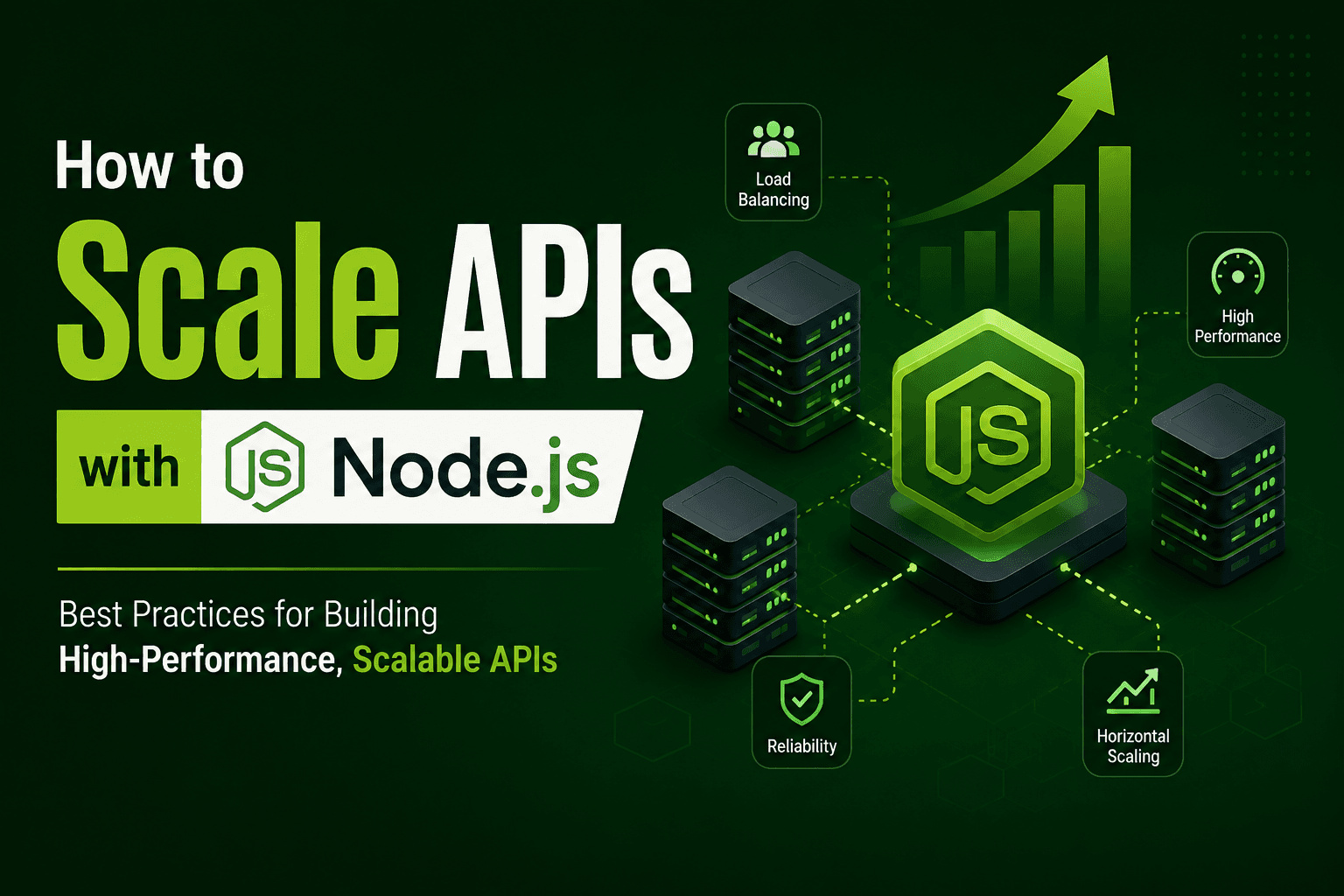
Put Node behind a load balancer. Use a connection pooler (PgBouncer) so 8 Node processes do not open 8 × 20 Postgres connections.
Docker helps you ship the same artifact to two boxes. If you are containerizing the Node side of a JS app, the production-build discipline in Dockerizing a TanStack Start app transfers: multi-stage builds, small runtime images, no leftover dev dependencies.
Architecture that holds up
A shape that works for NestJS services:
- API layer — guards, validation (Zod or class-validator), DTOs
- Application layer — use-cases, no HTTP types leaking in
- Infrastructure — Prisma/Drizzle, Redis, Stripe, email
- Workers — same codebase, different entrypoint, consume jobs
Keep the Next.js app as a client of this API, not as the place you hide business rules “because it was faster.” Server Actions are fine for some mutations; they are not an excuse to skip transactions and authorization.
Example: a list endpoint that refuses unbounded reads.
1const MAX_PAGE_SIZE = 50;
2
3interface MemberListQuery {
4tenantId: string;
5cursor?: string;
6limit?: number;
7}
8
9export const parseMemberListQuery = (input: MemberListQuery) => {
10const limit = Math.min(input.limit ?? 20, MAX_PAGE_SIZE);
11
12return {
13  tenantId: input.tenantId,
14  cursor: input.cursor,
15  limit,
16};
17};
Boring code. That is the point.
Performance considerations
Pooling: One pool per process. Size it for the database, not for “more is faster.”
Serialization: Huge JSON graphs are CPU. Paginate and slim payloads for mobile clients.
Compression: Enable at the reverse proxy. Do not gzip twice.
Cold starts: If you run serverless functions, a fat NestJS app may be the wrong unit. Long-running Node behind a proxy is still a valid, simpler scale story for many products.
Websockets: Fan-out is a different problem than REST. Do not bolt chat onto the same process that generates invoices unless you know why.
Common mistakes
Caching as a first move. You will cache bugs.
SELECT * plus ORM default includes that pull entire relation trees.
Doing reports in the request. “Export CSV” on the same box as checkout.
Ignoring idempotency on payments and webhooks. Stripe will retry.
Scaling to 12 microservices before you have 12 users. A modular monolith (NestJS modules) is a scale strategy.
No tenant_id on the query. You will leak data and you will not notice until a customer does. Pair this article with the PostgreSQL multi-tenant piece above.
Best practices
- Treat p95 latency as the number you manage, not average
- Put authorization next to the query, not only in the React sidebar
- Prefer explicit transactions for money and membership changes
- Load-test the real hot route, not
/health - Document the cache keys you invent — future you will invalidate the wrong one
When the API is the product behind dashboards like GymGrow, the backend work is mostly this: correct tenant scoping, predictable lists, and payments that do not double-apply.
Conclusion
Scaling a Node.js API is mostly database design, bounded queries, queues for heavy work, and then horizontal instances with a pooler. Framework choice (Express vs NestJS) matters less than whether every list is bounded and every mutation is authorized.
If you are still choosing a backend career path, read How to Become a Backend Developer with Node.js. If you need the data model that makes scaling possible in SaaS, start with PostgreSQL tenancy — not with another process manager.