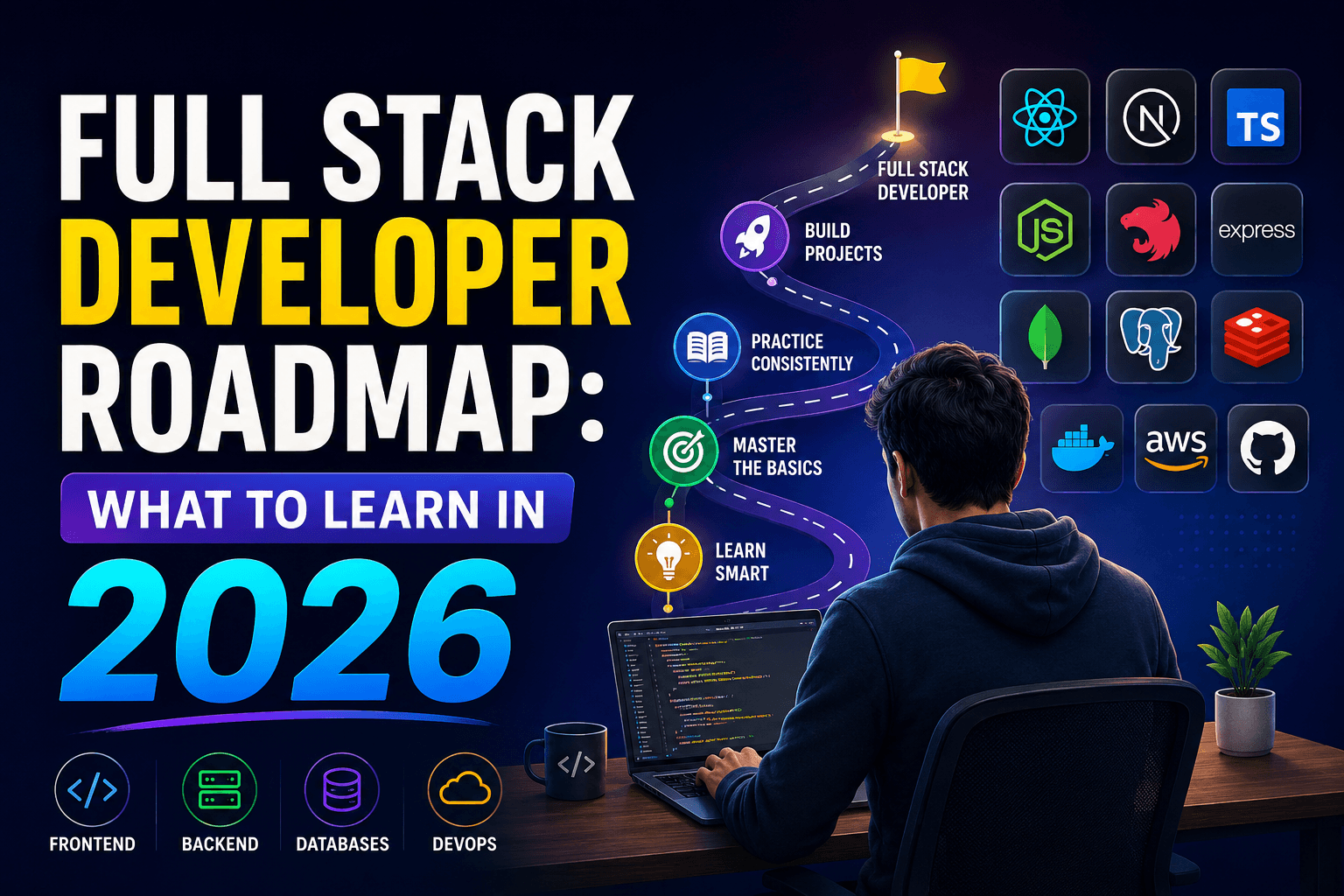
A full stack developer roadmap in 2026 is not “learn 40 tools.” It is a narrow spine: TypeScript, a React-based UI, a Node API, a relational database, Git, and deploy. Everything else is a branch you add when a job or a product requires it.
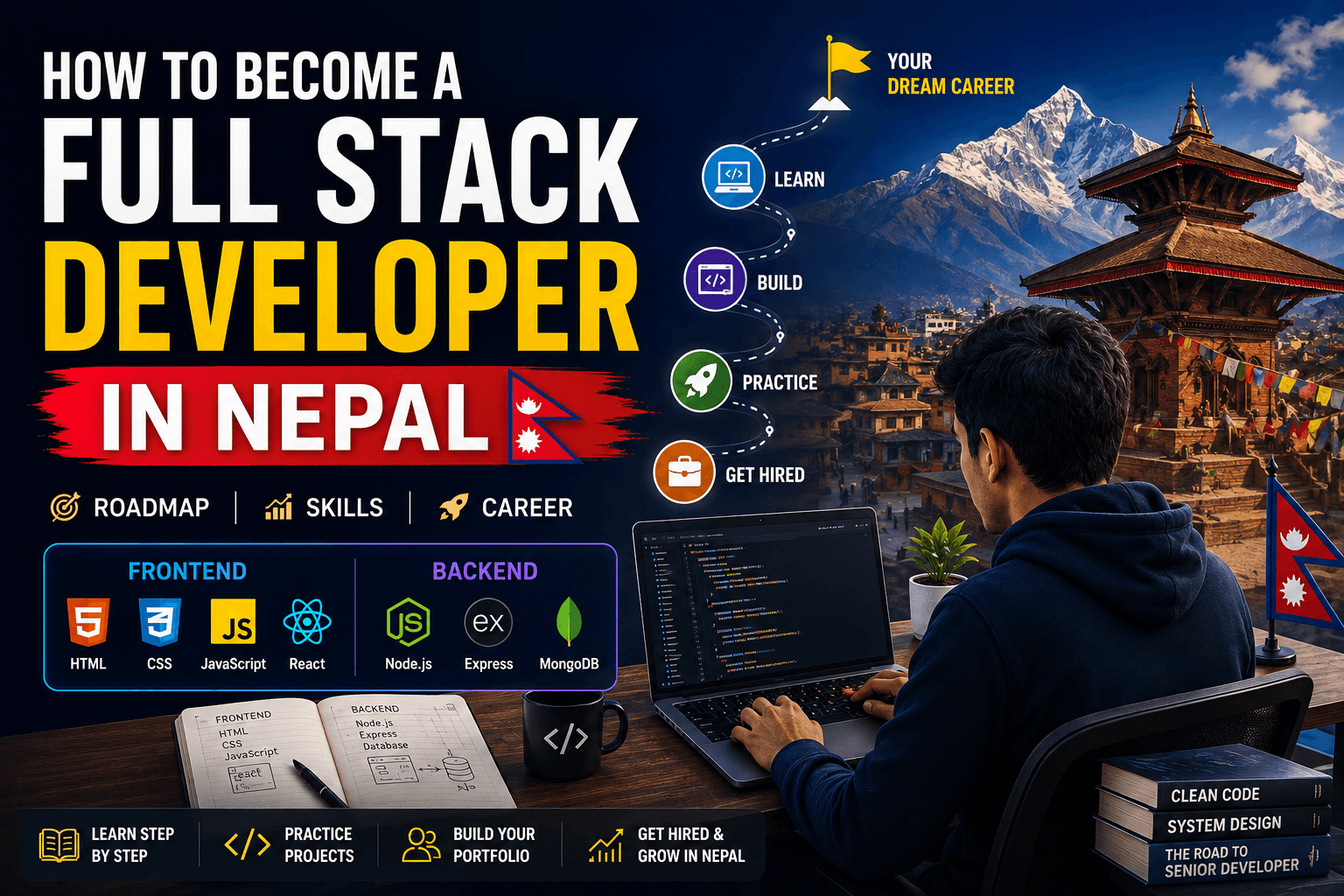
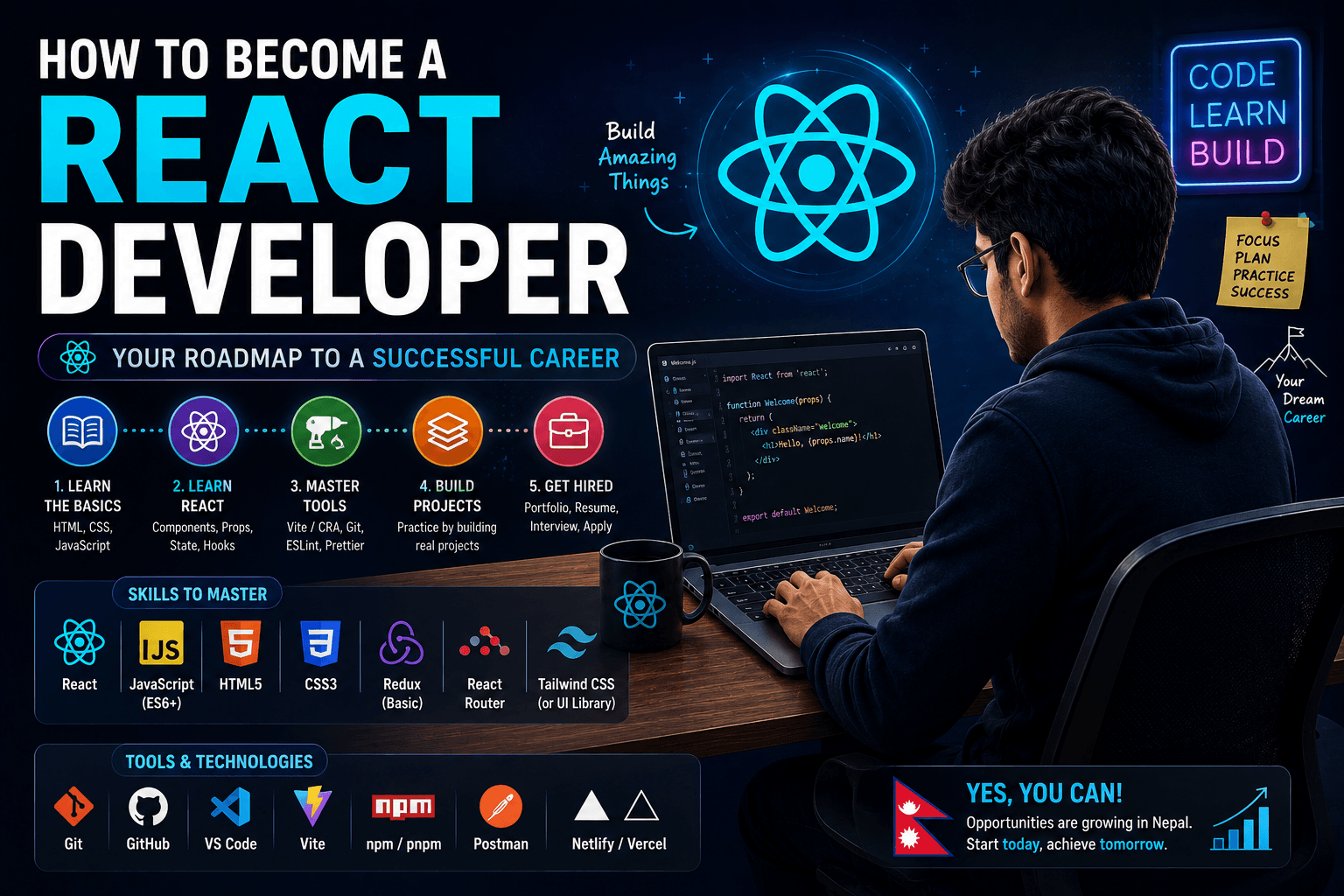
This is a learning-order article. For Nepal-specific hiring context, use How to Become a Full Stack Developer in Nepal. For frontend-only depth, use How to Become a React Developer.
Who this roadmap is for
- Students and career switchers who want a single map
- Junior developers who know a bit of everything and cannot finish a product
- Mid-level developers who need to fill a hole (usually SQL or TypeScript)
It assumes you will work on web products: SaaS dashboards, marketing sites, internal tools. Embedded, data science, and iOS-native tracks are different maps.
The 2026 spine (do this first)
1. TypeScript
Not optional on serious teams. Write it on both sides so your API types and
UI types can eventually be shared. Stop converting every error to unknown
and ignoring it.
2. HTTP and REST (or a well-typed RPC)
Status codes, JSON, idempotency, pagination. GraphQL is a later elective.
3. React + Next.js
React remains the hiring default. Next.js is how you ship SEO pages and apps together in 2026. Learn Server vs Client Components on purpose. See How to Build SEO-Friendly Apps with Next.js when you work on public pages.
4. Node.js + NestJS (or Express, then NestJS)
Node is still the shortest path from a JS frontend to a backend job. NestJS is what I reach for when the API will grow modules, guards, and multiple consumers. Express is a fine teaching tool. Production backends need structure.
5. PostgreSQL
Learn modeling, indexes, transactions, and migrations. MongoDB is useful for document-shaped data; it will not teach you relational thinking. Multi-tenant SaaS will force Postgres discipline — this schema article is the kind of problem you meet after CRUD tutorials.
6. Auth
Sessions or JWT, cookies, password hashing, role vs permission. UI that hides buttons is not security. Pair with permission-driven dashboards.
7. Git, CI, and one cloud deploy
GitHub Actions or similar. Preview deploys. Environment variables. Docker when you outgrow “it runs on my laptop.”
That is the roadmap. AI-assisted coding does not replace this spine. It makes a weak spine fail faster.
Recommended order (about 9–12 months if you are consistent)
| Phase | Focus | Output |
|---|---|---|
| 1 | HTML, CSS, JavaScript, Git | Static site and GitHub profile |
| 2 | TypeScript + React | SPA or Next.js app with routing |
| 3 | Next.js data + forms | Auth-aware pages with Zod validation |
| 4 | Node.js API + PostgreSQL | CRUD API with real database constraints |
| 5 | Integration | Full-stack application, deployed with a clear README |
| 6 | Hardening | Tests for risky paths, logging, pagination, and error handling |
Do not parallelize all six. Finish a phase with a URL.
Tools that are worth learning in 2026
Worth it
- TypeScript, React, Next.js, Node.js, NestJS, PostgreSQL
- TanStack Query for server state
- Tailwind + accessible component primitives
- Zod
- Redis when you have a real cache or queue need
- Docker for repeatable deploys
Learn when the job needs it
- Kafka / event buses — useful in distributed systems; not a junior filter
- Kubernetes — ops role adjacent
- React Native — a different product surface
- GraphQL — if the team already has it
Skip as identity
- Rewriting your portfolio in every new meta-framework
- Collecting 12 state libraries
I use TanStack Query heavily in product UIs. I also keep a skills list honest: the tools I actually ship, not a conference agenda.
Projects to build (one per phase)
- Personal site with MDX or a CMS — you need SEO practice anyway. For an example of a production developer portfolio, see the full-stack developer portfolio.
- Issue tracker or CRM slice — lists, filters, permissions
- API + Postgres for that slice — no
SELECT * - Payments or webhooks — even a test-mode Stripe flow teaches idempotency
- A second tenant or role — so you cannot cheat with global queries
Case studies on a projects page beat a wall of tutorial clones. Walk through one product in interviews the way you would GymGrow: users, roles, money, and operational screens.
What changed vs 2022 (and what did not)
Changed: Server Components, more TypeScript-by-default, AI pair programming, more “full stack” job posts that are really Next.js plus a thin API.
Not changed: SQL, HTTP, accessibility, naming, and reviewing diffs.
If a course still starts with class components and a REST-less Firebase-only todo, it is a history lesson.
Common mistakes on roadmaps
Infinite electives. You do not need Rust this year.
No production build. npm run dev is not a career.
Skipping CSS. Full stack still ships UI.
Skipping SQL. “I use Prisma so I don’t need to know joins” lasts until the slow query.
Tutorial projects with no README. Interviewers open the repo on their phone.
How to stay job-ready
- Follow one production stack for 6 months
- Read changelogs for Next.js and Node LTS — not every Twitter framework fight
- Write down trade-offs in READMEs
- Practice explaining a system on a whiteboard or paper
- Apply before the roadmap feels complete
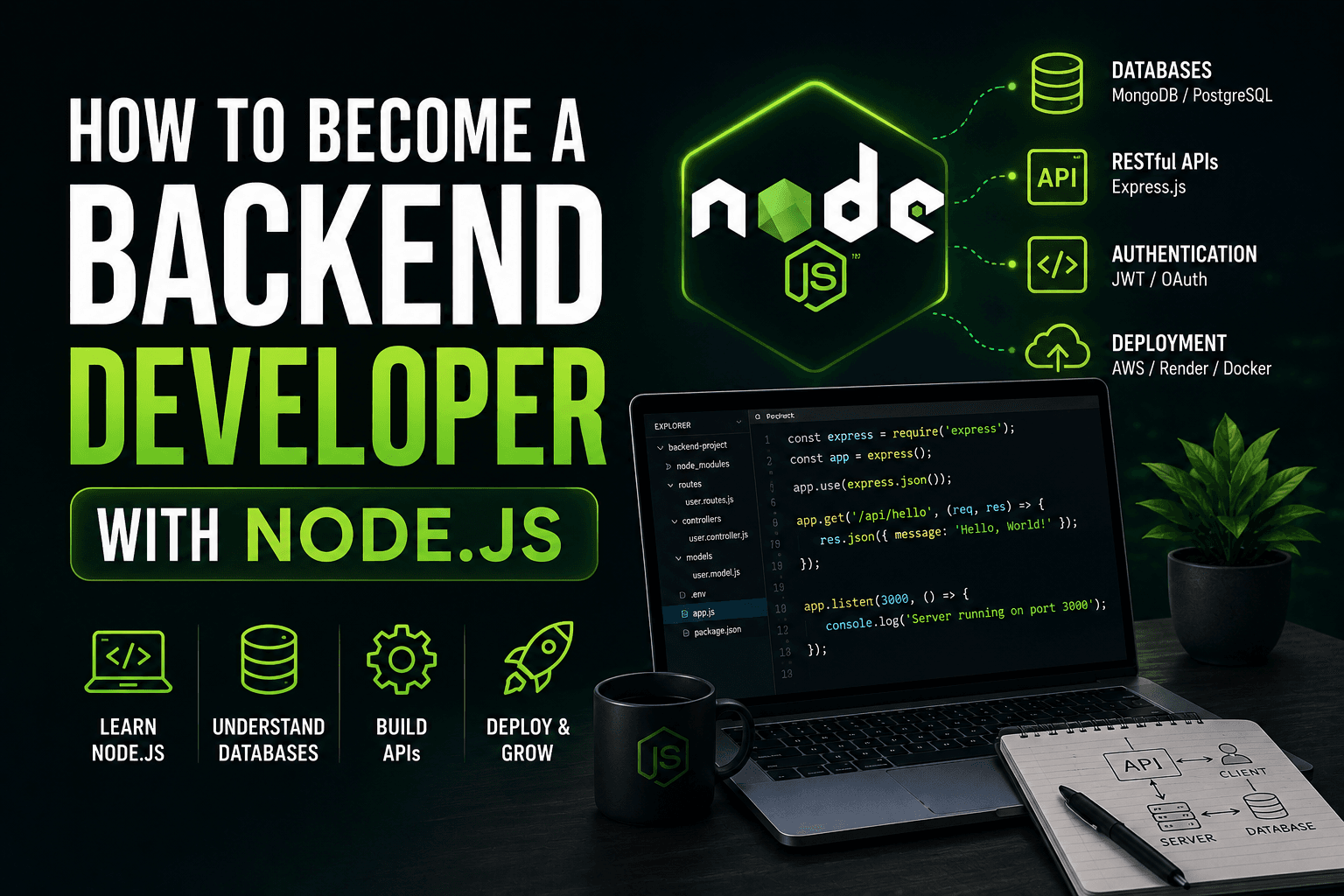
Backend-heavy? Use How to Become a Backend Developer with Node.js and How to Scale APIs with Node.js. Frontend-heavy? Stay on the React article until your UI is embarrassing in a good way — polished, typed, deployed.
Conclusion
The 2026 full stack developer roadmap is a spine: TypeScript, Next.js, Node, PostgreSQL, auth, deploy. Add Redis, queues, and extra cloud when a bottleneck appears — not when a YouTube thumbnail appears.
If you want the Nepal-shaped version of hiring and local payments, read that guide next. If you want to work as a software engineer who can still design UI, keep shipping products you can demo in five minutes.
Learn less. Finish more.