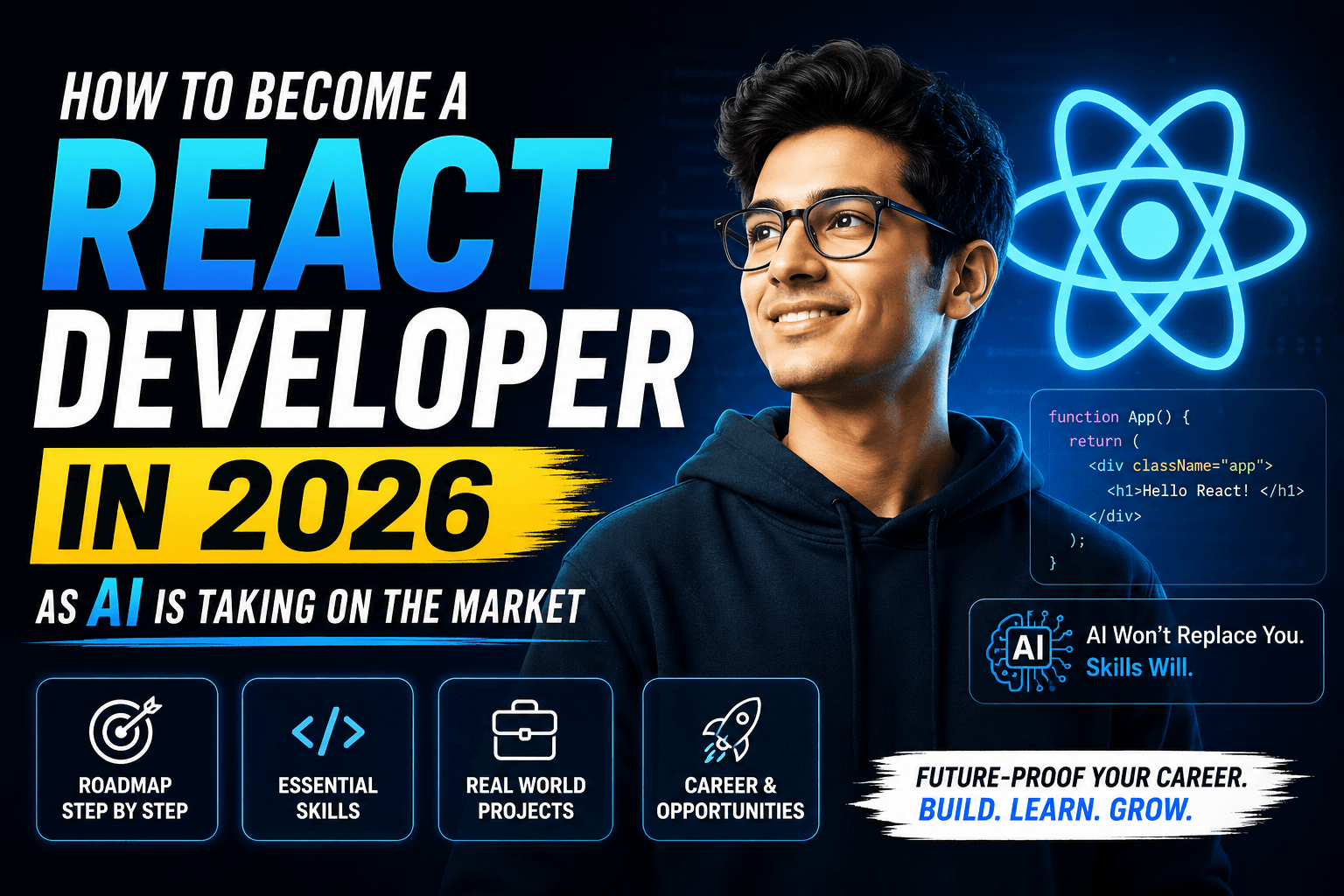
Every few months someone asks a version of the same question: is it still worth becoming a React developer when AI can generate a working component from a one-line prompt? It's a fair question, and it deserves a more honest answer than either extreme gets — "AI will replace all developers" and "nothing has changed" are both wrong in ways that matter for how you'd actually spend the next year of learning.
This is my attempt at the honest middle: what's genuinely different about becoming a React developer in 2026, what the data actually shows, and a practical roadmap that holds up whether AI keeps accelerating or plateaus.
What the data actually shows, not the headlines
It's worth separating the two claims that get conflated constantly.
Claim one: AI is changing what developers spend their day doing. This one is well supported. Coding assistants are now a daily part of most developers' workflow, and the tasks shifting are the routine, boilerplate ones — scaffolding, repetitive CRUD, first-draft implementations — while more time goes into reviewing, integrating, and deciding whether AI-generated code is actually correct and maintainable. Multiple 2026 industry surveys point the same direction: less time typing code from scratch, more time supervising and validating it.
Claim two: AI is causing mass developer unemployment. This one is not well supported by the numbers. Software developer employment has continued to grow through 2025 and into 2026, and global developer headcount reached a new high. That doesn't mean the picture is comfortable — computer science graduates and junior developers specifically have reported a noticeably harder job market than experienced developers, and hiring for pure "translate a spec into code" roles has softened. The layoffs happening at large tech companies are real, but they're happening alongside continued net growth in developer roles overall, and the two aren't obviously the same story.
The honest summary: the job isn't disappearing, but the entry point into the job is getting narrower and the day-to-day work is shifting toward judgment over typing speed. That's the environment the rest of this roadmap is built for.
What's actually changing about the React developer role
Less "write this component," more "is this component right"
A component scaffolded by an AI assistant is often plausible — it compiles, it renders, it looks reasonable in a quick glance. Whether it handles the actual edge cases, whether it introduces a re-render problem, whether it matches the rest of the codebase's conventions — that still needs a person who understands React deeply enough to catch what "looks right" but isn't. That's a harder skill than writing the component from scratch, not an easier one.
Fundamentals matter more, not less
There's a genuine failure mode showing up in industry data: developers who lean on AI without a solid grounding in fundamentals produce more code faster, but with more duplication and less refactoring — the code accumulates rather than improves. If you don't understand what "good" React looks like, you can't tell when the AI-generated version isn't it. AI raises the ceiling for someone who already knows what correct looks like; it doesn't substitute for knowing.
The entry-level squeeze is real, and worth planning around
Junior-focused, spec-to-code roles are exactly the ones AI tools are best at partially automating. This doesn't mean junior developers can't get hired — it means the bar for "junior" has moved. Getting hired at that level increasingly means being able to do things AI is worse at: understanding why a design decision was made, debugging something with no clear cause, reasoning about a system rather than a snippet.
The roadmap: what to actually learn
1. React fundamentals, deliberately, not just by using them
Know what actually triggers a re-render, why keys matter in lists, how the
reconciliation model works, when useEffect is the wrong tool. Not because
you'll type useEffect from memory forever, but because you need to be able
to read AI-generated code and immediately spot when it's misusing these.
2. TypeScript, properly
TypeScript is no longer optional for a serious React role, and the bar has
moved past "add types so it compiles" to actually modeling your domain with
types — discriminated unions for state machines, proper generic constraints,
narrowing instead of casting. AI-generated TypeScript is frequently
technically valid and semantically loose (any sprinkled in, overly broad
types) — catching that requires understanding the type system, not just
using it.
3. State management and data fetching, understood not memorized
Know the actual trade-offs between client state, server state, and URL state — not just which library to import. Understand what a library like React Query is solving (caching, invalidation, request deduplication) well enough to reason about it when the default configuration doesn't fit your case.
4. System design at the frontend level
How you'd structure a growing app, where feature boundaries should sit, how data flows from the API to the UI, how you'd handle authentication and authorization on the client. This is the kind of judgment call an AI assistant won't reliably make for you, because it depends on context about your specific product and team that isn't in the prompt.
5. Testing — writing them and, increasingly, reviewing them
AI is quite good at generating tests. It's also good at generating tests that pass without actually testing the thing that matters. Knowing what a test should verify, and catching when a generated test is testing the mock instead of the behavior, is a skill in its own right now.
6. Backend-adjacent literacy
Full-stack-leaning React developers — comfortable enough with an API layer, a database, and how deployment works — remain more resilient than purely component-focused ones, because "build the whole feature" roles are less automatable than "implement this isolated UI piece" roles.
7. Using AI tools deliberately, as a skill in itself
This deserves to be explicit rather than assumed. Knowing how to prompt for a useful first draft, how to review AI output critically instead of accepting it, and when not to reach for AI at all (a genuinely novel bug, a security-sensitive piece of code) is now a real part of the job, not a shortcut around it. Treat it the way you'd treat learning to use a linter or a debugger well — a tool that amplifies whatever skill level you bring to it.
Building proof of work that actually demonstrates judgment
A portfolio of AI-scaffolded CRUD apps demonstrates that you can prompt an AI assistant — which, increasingly, is assumed rather than impressive. What stands out instead:
- A project with a genuinely hard problem in it — a complex form with interdependent validation, a real-time feature, an offline-capable flow — something that required understanding rather than assembly.
- Writing about your decisions, not just the finished code. A README or blog post explaining why you chose a particular state management approach, what you tried that didn't work, and the trade-off you landed on demonstrates the exact judgment that's becoming the differentiator.
- Code that shows you can read and improve existing code, not just greenfield projects — contributing to an open-source project, or a before/after refactor writeup, signals the "supervise and improve" skill that the role is shifting toward.
Alternative views worth taking seriously
I don't think the picture above is the only reasonable read, and it's worth naming the disagreements honestly rather than pretending the debate is settled.
The more pessimistic view: some engineers argue that as AI models keep improving, the "judgment and review" tasks left for humans will themselves keep shrinking, and that betting a career on "AI needs supervision" is betting against the trend line of the last few years, not with it. Coding agents that operate with less human oversight are already a stated direction for several major AI labs and tools.
The more optimistic view: others point out that software's actual bottleneck has rarely been typing speed — it's been correctly understanding ambiguous requirements, coordinating across a team, and making trade-offs under real constraints, none of which current AI tools do reliably without a human driving. On this view, AI mostly removes the least differentiating part of the job, and demand for people who can do the differentiating part well doesn't shrink — it concentrates.
Both views are held by serious, informed people, and reasonable outcomes exist between them. I'd rather build skills that are useful under either version of the future than bet the roadmap on one being right.
Common mistakes
- Treating AI-generated code as correct by default instead of reviewing it with the same scrutiny you'd apply to a pull request from someone else.
- Skipping fundamentals because "AI can write it" — you can't review or debug what you don't understand yourself.
- Building a portfolio of tutorial-shaped projects that don't demonstrate a decision you actually had to make.
- Ignoring TypeScript, testing, or system design as "not fun" parts of the job — these are exactly the parts becoming more valuable, not less.
- Refusing to use AI tools at all, out of principle or discomfort — that forfeits a real productivity advantage other candidates will have.
- Assuming the junior path looks the same as it did five years ago — plan for a narrower entry point and build toward it deliberately.
Practical recommendations
- Learn React's actual mechanics, not just its API surface — you need to recognize wrong code, not just working code.
- Get properly fluent in TypeScript; don't stop at "the compiler is happy."
- Build at least one project with a genuinely hard problem, and write about the decisions behind it.
- Practice reviewing code — your own AI-generated drafts included — with a critical eye, not just running it and moving on.
- Pick up enough backend and deployment literacy to own a feature end to end, not just its UI layer.
- Use AI tools daily, deliberately, and stay honest with yourself about when their output needs real scrutiny versus when it's genuinely fine.
Conclusion
Becoming a React developer in 2026 isn't a worse bet than it was in 2020 — it's a different one. The skills that mattered before AI — understanding how React actually behaves, knowing what good code looks like, and being able to reason about a system rather than a snippet — matter more now, because they're what let you tell the difference between AI output that's fine and AI output that only looks fine. The parts of the job that are shrinking were never the differentiating parts to begin with. For developers building toward a career as a full-stack software developer, those fundamentals remain valuable well beyond any particular framework or AI tool.
Nobody, including people building these AI tools, has full certainty about where this goes in another two years. What's a reasonable bet either way is building real understanding instead of just fluency with a prompt box — that holds up whether the trend line keeps bending toward more automation or levels off.